

The word "psychosomatic" has been misused for decades. It came to mean "it's in your head" — a way of dismissing symptoms that medicine couldn't explain. That is precisely backwards.
Psychosomatic means that the psyche and the soma — the mind and the body — are not two separate systems. They are one. Every emotional experience has a physical location. Every chronic tension, every held breath, every tightness in the chest is the body's way of storing something that was never fully processed.
What is psychosomatic embodiment?




Embodiment is the practice of returning to that. Not as a concept, but as a lived experience.
Psychosomatic embodiment is the process of learning to feel what is actually happening inside you — and understanding what it means. It is the recognition that your anxiety is not a malfunction. Your emotional numbness is not weakness. Your relational patterns are not character flaws. They are intelligent adaptations to experiences your nervous system once had to survive.
The work is not to fix these responses. It is to meet them — with enough safety, enough awareness, and enough support — so that the body can finally do what it has always wanted to do: complete the experience, release what was held, and reorganize around something new.
This is not self-improvement. It is self-recognition.




How does emotional release work in the body?

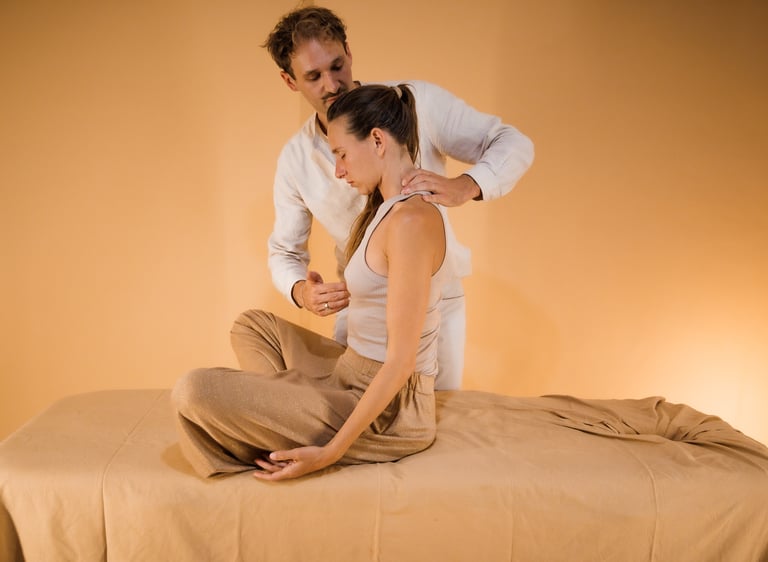


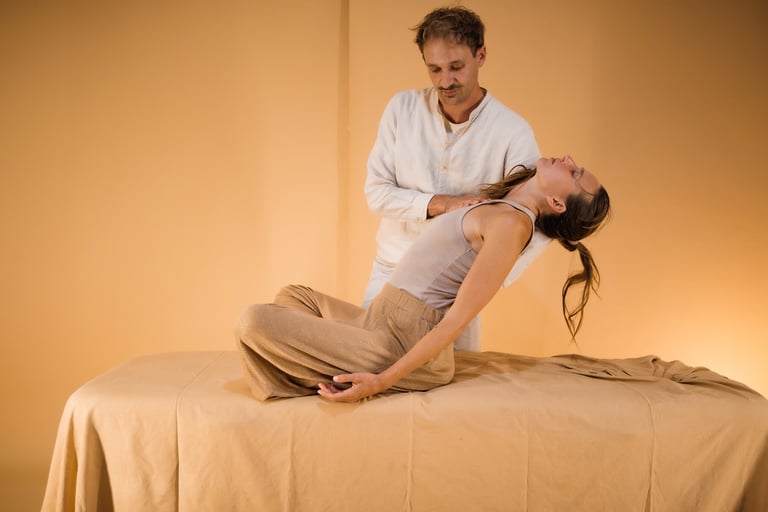
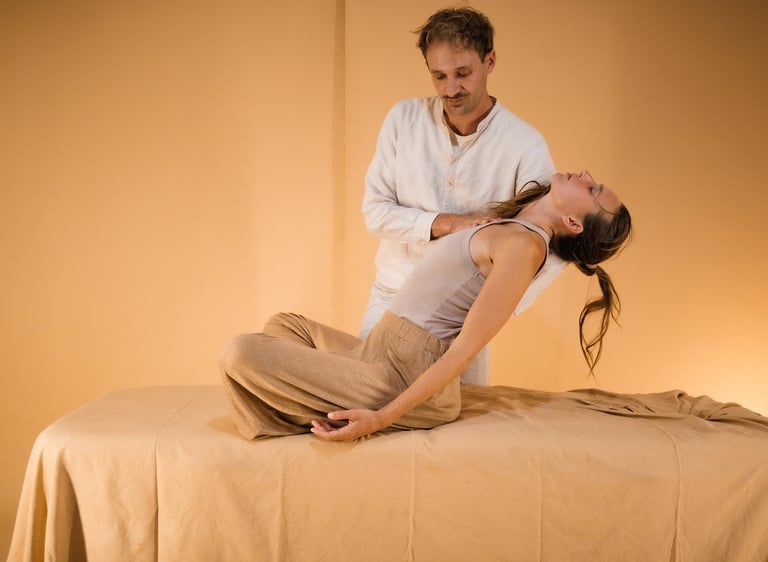






Most of us were taught, directly or indirectly, that emotions are meant to be managed.
Controlled. Kept at an appropriate volume. We learned to breathe through the anger, think past the grief, push down the fear and keep moving.
The body remembers all of it.
Emotional release is the process of allowing those incomplete cycles to finish. Not by forcing emotion, not by performing it, but by creating the conditions in which the body feels safe enough to move what has been held still.
In practice this looks different for everyone. For some it is breath and movement. For others it is sound, or stillness, or finally saying the thing that was never allowed to be said.
What matters is not the technique. What matters is whether the experience reaches the body, not just the mind.
Emotions are not psychological events that happen to have physical symptoms. They are physiological processes, waves of energy that move through the nervous system and are designed, by nature, to complete.
When they are interrupted, through suppression, through shame, through simply not having a safe enough space to be felt, they do not disappear.
They stall. They compress into the tissue. They become chronic tension, digestive issues, fatigue, numbness, or a low-grade anxiety that never fully lifts.
This is not poetic language. This is how the nervous system works.




This is the critical distinction. Insight alone does not release.
Understanding why you are the way you are does not change the nervous system's memory. What changes it is a new experience, felt, not just understood.
Regulation techniques have their place. But regulation without expression only teaches the body to contain more efficiently. True release is not containment. It is completion.
And after completion, often for the first time in years, there is space. Clarity.
A body that feels like somewhere you can actually live.
What Is a Core Wound?
In psychosomatic coaching, the term "core wound" refers to something precise.
It is not a dramatic event or a single memory. It is a pattern, formed early, stored in the body, and quietly organizing your beliefs, your relationships, and your capacity to feel safe in the world.
And Why Identifying Yours Changes Everything



The psychosomatic understanding of a core wound
Every human being moves through distinct developmental stages in early life. At each stage, the nervous system asks a fundamental question — about belonging, about safety, about worth, about love. When those needs are consistently unmet — through neglect, emotional absence, overwhelm, or relational disruption — the body doesn't simply register disappointment. It adapts. It contracts. It builds a strategy for survival.
That adaptation becomes the core wound.
In psychosomatic work, a core wound lives at the intersection of four layers:
Root dynamics — the earliest relational imprints from caregivers and family systems
Developmental stages — the specific phase of growth during which the wound formed
Belief systems — the conclusions the mind drew from those early experiences ("I am too much," "I am not enough," "I must earn love," "I cannot trust")
Somatic rights — the embodied sense of whether you have the right to exist, to feel, to take up space, to receive, to act
Why this is the foundation of lasting change
Most coaching and psychotherapy approaches work with one or two of these layers. They address the belief, or the behavior, or the body — separately. This creates partial results.
Psychosomatic coaching works at the intersection of all four simultaneously. Because the wound did not form in one layer, it cannot integrate in one layer.
The core wound is not a diagnosis. It is a map. And once you have that map, every area of your life — your relationships, your work, your physical symptoms, your emotional patterns — begins to reorganize around a new understanding.
When these four layers are understood together,
the symptom as anxiety, relational conflict, chronic tension, emotional numbness, self-sabotage, they all stop looking like a problem. They start making complete sense as survival strategies
What happens in an initial call?
In a first session, we do not begin with your history. We begin with what is present — in your body, in your language, in what you avoid and what you reach for. From there, we trace the pattern backward: from the current symptom to the underlying dynamic, from the dynamic to its developmental origin, from the origin to the belief it produced and the somatic right it interrupted.
By the end of that conversation, most people have a clearer picture of themselves than years of analysis provided. Not because the answer was hidden — but because it had never been seen whole.
Who this work is for?
This approach is particularly relevant for people experiencing:
Recurring relational patterns that repeat across different partners or contexts
A sense of emotional flatness, disconnection, or chronic overwhelm
Physical symptoms without clear medical explanation
The feeling of being stuck despite significant insight or self-awareness
A desire to integrate rather than manage their inner world